Sovereign Cloud in Europe: How Open Source Is Outpacing Hyperscalers in GDPR Compliance
- 3 days ago
- 5 min read
Sovereign Cloud in Europe: Why Open Source Beats Hyperscalers in GDPR Compliance
There's a question many European IT managers and DPOs are asking themselves in 2026: are corporate data on AWS, Azure, or Google Cloud really safe from a legal and sovereignty perspective?
The answer, analyzing the current legislation, is more complex than American vendors let on.
The problem no American hyperscaler can solve
In 2018, the US Cloud Act—Clarifying Lawful Overseas Use of Data Act—went into effect. This law requires American technology companies to hand over their customers' data to US authorities upon request, regardless of where that data is physically hosted.
Translated into practical terms: if your data is on AWS Frankfurt, Azure Netherlands, or Google Cloud Belgium, American authorities can request access to that data without your knowledge and without the need for an international request for access.
This isn't a theoretical risk. It's a structural and permanent vulnerability of any cloud service operated by a company subject to US jurisdiction—regardless of where the servers are physically located.
The European GDPR, on the other hand, prohibits the transfer of personal data to third countries that do not guarantee an adequate level of protection. The tension between the US Cloud Act and the European GDPR is unresolvable as long as the data remains under the jurisdiction of a US provider.
What is a Sovereign Cloud and why is it different?
A Sovereign Cloud isn't simply a cloud with servers in Europe. It's an infrastructure specifically designed to ensure that data is under the full legal and operational sovereignty of the organization managing it.
There are four characteristics that define a true Sovereign Cloud.
Exclusive European jurisdiction. The data is hosted in data centers located in the EU, operated by companies subject exclusively to European jurisdiction. No non-European entity can access the data without European legal process.
Open-source software with no non-European dependencies. The infrastructure is based on open-source technologies— OpenStack , Kubernetes , Ceph—without dependencies on proprietary American software that could include backdoors or disclosure obligations to foreign authorities.
Encryption with keys under the customer's control. With BYOK (Bring Your Own Key) and HSM (Hardware Security Module), encryption keys are managed exclusively by the customer organization. Even the cloud provider cannot access the encrypted data.
Guaranteed reversibility. Data and configurations can be exported at any time in open standard formats. There's no vendor lock-in preventing you from switching providers.
The Face-Off: Open-Source Sovereign Cloud vs. American Hyperscalers
We analyze the critical points for European companies when choosing where to host their data.
US Cloud Act Compliance
AWS, Azure, Google Cloud: Subject to the Cloud Act — US authorities can request access to data at any time.
Open-source Sovereign Cloud Epic Edge: Not subject to the Cloud Act — the company is Italian, the data is in the EU, and it is not dependent on US entities.
GDPR Compliance
AWS, Azure, and Google Cloud: GDPR compliance declared but structurally at odds with the Cloud Act. Standard contractual clauses do not eliminate Cloud Act risk.
Sovereign Cloud open-source Epic Edge: native GDPR compliance — data in the EU, no transfer to third countries, continuous auditing, ISO 27001 certification.
Encryption key control
AWS, Azure, Google Cloud: they offer BYOK but the keys are still managed through their systems — in case of a US government request, the provider is obligated to cooperate.
Sovereign Cloud open-source Epic Edge: BYOK with physical or virtual HSMs under the customer’s sole control — Epic Edge has no access to encryption keys.
Vendor lock-in
AWS, Azure, Google Cloud: proprietary formats, proprietary APIs, and egress costs for data egress. Changing providers requires expensive migration projects.
Sovereign Cloud open-source Epic Edge: Open-source OpenStack and Kubernetes, standard formats, no egress costs, contractually guaranteed reversibility.
Long-term costs
AWS, Azure, Google Cloud: seemingly convenient pay-per-use models, but costs grow non-linearly with data volume and operations. Data egress costs are one of the most critical items.
Open-source Sovereign Cloud Epic Edge: Predictable and stable costs, no egress costs, no unilateral price increases.
Who needs a Sovereign Cloud most?
Not all organizations have the same urgency. These are the ones for which the Sovereign Cloud is not an option but a necessity.
Financial sector. Banks, insurance companies, and asset management companies are subject to EBA (European Banking Authority) and ECB regulations that require direct control over data and systems. Reliance on American providers exposes them to significant regulatory risks.
Healthcare. Healthcare data is among the most protected categories under the GDPR. Hosting it on American hyperscalers exposes them to both compliance and reputational risks in the event of a breach or request from foreign authorities.
Public Administration. Most European public administrations are already moving toward Sovereign Cloud solutions due to national regulatory requirements. In Italy, the ACN (National Cybersecurity Agency) framework requires a qualified cloud for sensitive public administration data.
Defense and security. Obviously not compatible with American solutions for any classified or sensitive data.
Companies with Critical IP. Any organization with strategic intellectual property—formulas, algorithms, patents, sensitive commercial data—should carefully evaluate the risk of hosting it on infrastructure subject to the Cloud Act.
NIS2 and Sovereign Cloud: The New European Obligation
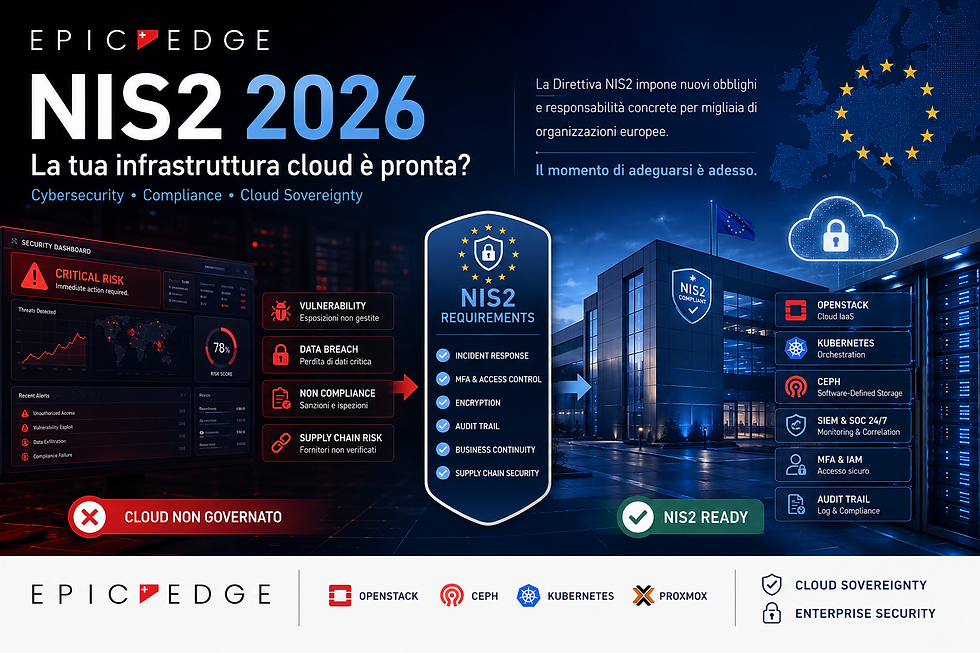
The NIS2 Directive, which came into force in October 2024, significantly extends the cybersecurity obligations for European organizations in critical sectors—energy, transport, healthcare, digital infrastructure, public administration, and space.
NIS2 requires technical and organizational measures to manage cyber risk, incident notification within 24 hours for major incidents and 72 hours for significant incidents, and direct management accountability for the security measures adopted.
An open-source Sovereign Cloud with 24/7 SIEM/SOC , full audit trail, and certified incident response procedures is the most effective answer to NIS2 requirements for organizations in critical industries.
Epic Edge's Sovereign Cloud: How It's Built
Epic Edge deploys Sovereign Cloud infrastructure based on OpenStack for compute and networking, Ceph for distributed storage, Kubernetes for containerized workloads, HashiCorp Vault for BYOK key management, physical or virtual HSMs for hardware key protection, and SIEM with 24/7 security event correlation.
All data centers are located in Italy and the EU. The company is subject exclusively to Italian and European jurisdiction. No component of the software stack includes dependencies on US entities subject to the Cloud Act.
ISO 27001 certification covers all information security management processes. The service includes periodic GDPR and NIS2 compliance audits with complete documentation for DPOs and compliance officers.
Migrating from hyperscaler to Sovereign Cloud: Is it complex?
It depends on your current architecture. For standard workloads—web applications, databases, storage— migrating from AWS or Azure to an OpenStack Sovereign Cloud is technically similar to any other cloud migration.
The main steps are an assessment of the current environment with a mapping of all cloud services used, identification of dependencies on hyperscalers' proprietary services, design of the target architecture on OpenStack and Kubernetes, progressive migration of workloads with systematic testing, and cut-over with minimal downtime.
Complexity increases for workloads that use hyperscaler proprietary services—Lambda, DynamoDB, BigQuery—that have no direct equivalent in OpenStack. In these cases, Epic Edge evaluates the most efficient replatforming path on a case-by-case basis.
Conclusion: Digital sovereignty is not a luxury, it is a necessity
2026 marks a tipping point for European digital sovereignty. Geopolitical tensions, the US Cloud Act, GDPR, NIS2, and European initiatives like Gaia-X are forcing organizations across all sectors to reconsider where and how they host their critical data.
The open-source Sovereign Cloud isn't a second-rate alternative to American hyperscalers. It's a strategic choice that guarantees legal independence, operational control, regulatory compliance, and long-term economic sustainability.
For European organizations in regulated sectors, it's no longer a question of technology preference. It's a matter of compliance, management accountability, and protecting corporate interests.
Are you considering migrating to the Sovereign Cloud for your organization?
Epic Edge offers a free assessment of your current infrastructure and a migration plan to the open-source, GDPR- and NIS2-compliant Sovereign Cloud.



Comments