Managed Kubernetes vs. Self-Hosted: Why 70% of Teams Fail Alone
- 6 days ago
- 6 min read
There is a conversation going on in almost every European engineering team right now: manage Kubernetes in-house or rely on a managed Kubernetes provider?
The answer seems obvious until you find yourself managing a production cluster at 3 AM with a critical incident and no one responding.
The problem with self-hosted Kubernetes that no one talks about
Kubernetes is an amazing technology. It's also one of the most complex platforms to manage in production long-term.
The promise of self-hosted is simple: total control, low costs, and no vendor lock-in. The operational reality is different. A 2025 CNCF study indicates that approximately 70% of organizations starting with self-hosted Kubernetes encounter significant stability, security, or operational issues within the first 18 months.
Not because Kubernetes is flawed. But because managing Kubernetes in production requires specialized skills that go far beyond the initial installation.
What it really means to run Kubernetes in production
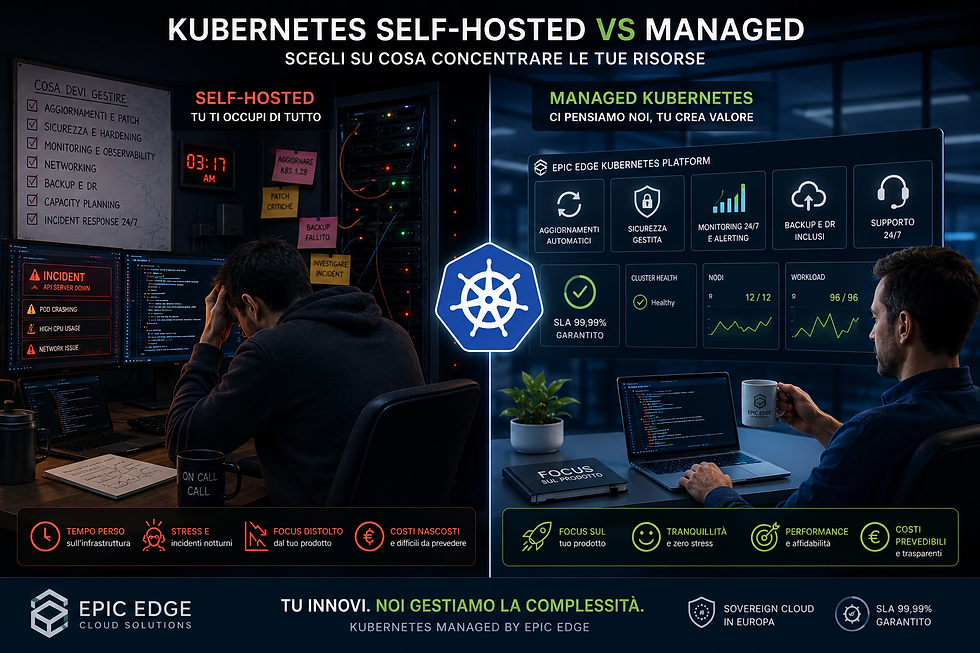
When a team decides to manage Kubernetes internally, they take on a long list of tasks that are often overlooked during the evaluation phase.
Updates and patches. Kubernetes releases new versions approximately every four months, with a 14-month support cycle for each version. Falling one or two versions behind exposes you to known security vulnerabilities and loses critical functionality. Upgrading a production cluster with critical workloads is not trivial—it requires planning, testing, and proven rollback procedures.
Security and hardening. A default Kubernetes cluster is insecure. It requires configuring RBAC, network policies, pod security standards, secrets management, container image scanning, audit logging, and much more. Each of these aspects requires specific skills and ongoing training on best practices.
Monitoring and observability. A Kubernetes cluster generates a huge amount of metrics, logs, and events. Setting up a complete observability stack—Prometheus, Grafana, Loki, Jaeger—requires weeks of work and ongoing maintenance. Without adequate monitoring, problems are discovered only when it's too late.
Networking. Networking in Kubernetes is one of the most complex aspects. CNI plugins, Ingress controllers, Service Mesh, internal DNS, Network Policies—every choice has performance, security, and maintainability implications that become critical in production.
Backup and disaster recovery. Kubernetes does not include native backups of workloads and persistent data. Implementing a backup and disaster recovery strategy for a production cluster requires additional tools, tested procedures, and documented recovery plans.
Capacity planning. How many nodes are needed? When to scale? How to handle traffic spikes? Capacity planning for a Kubernetes cluster requires continuous analysis of usage patterns and the ability to react quickly.
The hidden cost of self-hosting
The apparent cost of self-hosted Kubernetes is just the hardware or cloud computing. The real cost includes much more.
Engineer time. Running a Kubernetes cluster in production requires an average of 0.5-1 FTE dedicated solely to operations, depending on its complexity. For a team of 5-10 engineers, this means a significant portion of production capacity is absorbed by infrastructure rather than product development.
Continuous training. The Kubernetes ecosystem is evolving rapidly. Keeping skills up to date requires time and investment in ongoing training.
Incident response. When a cluster goes down at 3 a.m., who responds? An internal team covering 24/7 requires on-call rotations, which comes at a significant cost in terms of compensation and the team's quality of life.
Missed opportunities. The most difficult cost to quantify is the cost of product features not developed because the team was busy solving infrastructure issues.
Managed Kubernetes: what actually changes
With Kubernetes managed by a specialized provider like Epic Edge, the engineering team focuses on application development while all the operational complexity is handled by those who do this as their core business.
Automatic and scheduled updates. Cluster updates are performed by the provider using tested procedures, within agreed-upon maintenance windows, and with rollback procedures in place. The team doesn't have to worry about falling behind on releases.
Managed security. RBAC, network policies, vulnerability scanning, cluster hardening—all configured and maintained by the provider according to the latest best practices. Critical security updates are applied without waiting for the next planning sprint.
Monitoring and alerting included. Complete observability stack configured and monitored 24/7. Alerts reach the provider before the issue impacts end users.
Guaranteed SLA. With Epic Edge, the SLA is 99.99%—that's less than 53 minutes of downtime per year. For a self-hosted team, ensuring this level of availability requires significant investments in redundancy and operational procedures.
24/7 Support. Critical incidents at 3 AM are handled by the Epic Edge NOC/SOC team, not your on-duty engineer.
The comparison: self-hosted vs managed Kubernetes
Let's analyze the main factors on which organizations base this decision.
Total cost
Self-hosted: compute cost + 0.5-1 operational FTE + training + monitoring, backup, and security tools. For a medium-sized cluster, the annual TCO is rarely less than €80,000-120,000 when all real costs are considered.
Managed Epic Edge: Epic Edge designs, deploys, and manages Kubernetes clusters on customer-owned infrastructure or in dedicated data centers — updates, patching, monitoring, incident response, and continuous optimization are all handled by the Epic Edge team, with a 99.99% SLA and 24/7 NOC/SOC support.
Check
Self-hosted: Complete control over every aspect of the cluster. Ideal for organizations with very specific requirements that can't be met by a single provider.
Managed Epic Edge: Complete control over workloads and applications. Operational management of the infrastructure is delegated to the provider, but the customer maintains full visibility and access to the cluster.
Security and compliance
Self-hosted: Security depends entirely on the skills and availability of the internal team. GDPR and NIS2 require documentation and audits that must be produced internally.
Managed Epic Edge: cluster on open-source infrastructure deployed in customer environments or in agreed European data centers, GDPR and ISO 27001 compliant
Scalability
Self-hosted: Scaling a self-hosted cluster requires capacity planning, provisioning new nodes, and configuration. Response latency can be high during sudden spikes.
Managed Epic Edge: Autoscaling configured and tested. New nodes are added automatically based on load, without manual intervention.
Vendor lock-in
Self-hosted: zero lock-in by definition.
Managed Epic Edge: Zero lock-in thanks to the use of standard open-source Kubernetes. The cluster is portable and workloads can be migrated to any other Kubernetes infrastructure at any time.
When self-hosting makes sense
Self-hosting isn't always the wrong choice. It makes sense in these specific scenarios.
Teams with proven Kubernetes expertise. If your team has engineers with years of experience with Kubernetes in production and infrastructure management is a core part of your business, self-hosting may be the right choice.
Very specific requirements. Some organizations have such specific compliance or architectural requirements that no managed provider can fully meet them. In these cases, self-hosting is the only option.
Development and test cluster. For non-critical environments, self-hosting is perfectly adequate and cost-effective.
When managed Kubernetes is the obvious choice
For most European organizations in 2026, managed Kubernetes is the most rational choice in these scenarios.
Product-focused team. If your core business is developing software and not managing infrastructure, managed Kubernetes frees your team to focus on what creates value.
AI and ML workloads. Machine learning workloads require specific configurations (GPUs, high-performance storage, low-latency networking) that a specialized provider can configure and optimize better than a generalist team.
High SLA requirements. For business-critical applications with stringent SLAs, ensuring 99.99% availability with an in-house team requires disproportionate investments compared to the cost of a managed provider.
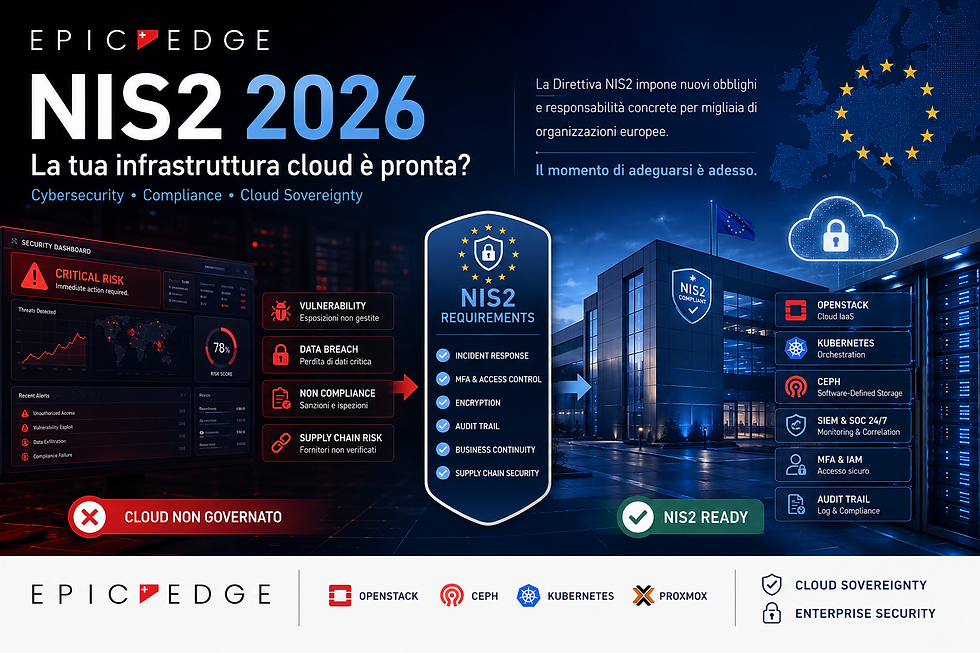
GDPR and NIS2 Compliance. Organizations in regulated industries that need to demonstrate GDPR and NIS2 compliance find it much easier to do so with a provider that produces compliance documentation as part of the service.
Epic Edge Managed Kubernetes: How It Works
Epic Edge designs and deploys private Kubernetes clusters on open-source OpenStack or Proxmox VE infrastructure — on customer hardware, in colocation, or in dedicated data centers — with 100% EU-based data and full data sovereignty guaranteed.
Each cluster includes high availability with a redundant control plane across three master nodes, auto-scaling of worker nodes based on load, networking with Calico or Cilium for performance and security, persistent storage with Ceph for high availability and performance, a full monitoring stack with Prometheus, Grafana and alerting, CI/CD integration with GitLab, Jenkins or GitHub Actions, and automatic backup with a customizable retention policy.
All managed by the Epic Edge NOC/SOC team 24/7 with 99.99% SLA and guaranteed incident response within 15 minutes for P1.
For AI and ML workloads, Epic Edge configures optimized clusters with GPU support, Kubeflow and JupyterHub operators, and on-premises LLM via SentinelForge AI for completely private inferencing with no data outside the edge.
Conclusion: the right question to ask yourself
The question isn't "managed or self-hosted?" but "what's the best use of my team's time and skills?"
For most European organizations, the answer is clear: delegate the operational complexity of Kubernetes to those who do it as a core business, and focus internal energies on what creates value for customers.
Managed Kubernetes isn't a relinquishment of control. It's a strategic choice to use resources as efficiently as possible.
Thinking about moving to managed Kubernetes?
Epic Edge offers an assessment of your current Kubernetes infrastructure—self-hosted or public cloud—and a plan to deploy and manage open-source private Kubernetes clusters on your infrastructure.


Comments